

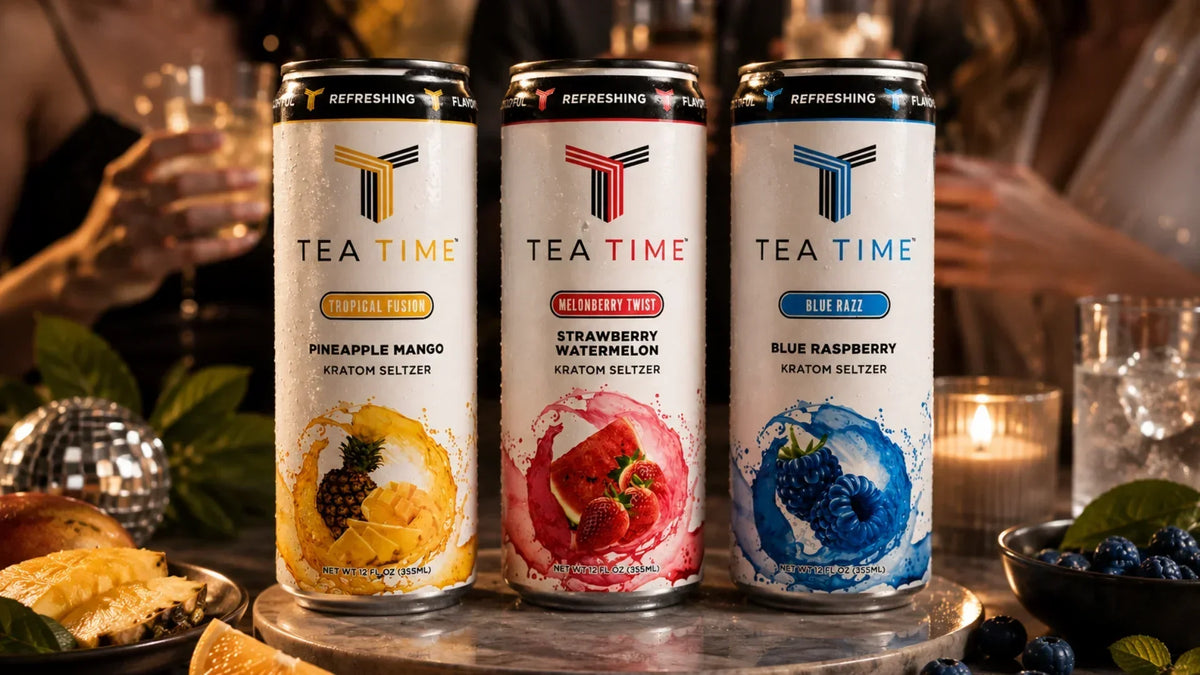
Kratom seltzer is a ready-to-drink beverage containing kratom ingredients. The can format does not establish how a particular person will respond, and an alcohol-free label is not a guarantee against impairment.
Kratom seltzers differ from powders and shots in packaging, flavor, and preparation. Compare the current label and product information for each format.
This guide covers botanical ingredients, product labels, beverage formats, and safety information.
Kratom Ingredients and Product Information
Kratom ingredients are derived from Mitragyna speciosa, a tree native to Southeast Asia. Its leaves contain naturally occurring alkaloids, including mitragynine.

Published kratom research provides background about the plant and its alkaloids. For a particular beverage, use the current label and product documentation.
1. Mitragynine on Product Labels
Mitragynine is the most abundant alkaloid in the plant, often making up 60% or more of the total alkaloid profile.
Compare the labeled mitragynine amount with the full ingredient list and corresponding laboratory report. Research on mitragynine provides additional background.
2. 7-Hydroxymitragynine (7-OH) and Hepatic Conversion
7-hydroxymitragynine (7-OH) is a naturally occurring minor alkaloid found in Kratom leaves. Research has also explored whether mitragynine can be metabolized into 7-OH through enzymatic pathways, including CYP-related metabolism. However, the relationship between metabolite formation and how individuals describe their experience with Kratom products is still being studied and may vary depending on factors such as product formulation and individual metabolism.
3. Product Formats and Preparation
Kratom products differ in their ingredients, packaging, and preparation:
- Extract information: Review the label to identify the ingredient or extract used in the particular product.
- Preparation: Powder requires preparation, while canned beverages are sold ready to drink.
- Packaging: Cans and shots differ in container size. Review serving information rather than assuming an amount from the package.
If you are exploring alternative ways to consume botanicals, check out our complete breakdown on kratom drinks guide.
What to Check Before Purchasing
Use the current product label and laboratory documentation to compare a specific beverage.
These label and documentation checks can help identify what a product contains:
|
Product Detail |
What to Check |
Why It Matters |
|
Ingredient List |
Kratom ingredients, flavorings, sweeteners, and other botanicals |
Identifies the listed contents of the specific beverage |
|
Labeled Amounts |
Declared extract or alkaloid amount per labeled serving |
Distinguishes concentration information from package size |
|
Serving Information |
Serving size and servings per container |
Clarifies how the label describes the container |
|
Laboratory Report |
Product name, batch number, test date, and reported results |
Connects the report to the particular product or batch |
|
Warnings |
Product warnings and interaction information |
Provides cautions to review before considering personal use |
Comparing Labeled Product Information
Product labels state the ingredients and amounts in the beverage. Compare these details for the specific product.
Mitragynine Amount
- Check the declared mitragynine or extract amount for the labeled serving.
- Compare serving information and the number of servings in the container.
Full Ingredient Panel
- When comparing Tea Time Drinks products, review the complete ingredient list, including other botanicals, sweeteners, and added caffeine.
- Compare the specific product’s formulation rather than assuming that products with similar packaging contain the same ingredients.
Batch Laboratory Report
- Look for a laboratory report that identifies the product or batch.
- Compare the report date, tested ingredients, and reported results with the current product information.
Product Information Checklist
Review the product’s label, warnings, and available laboratory documentation before considering personal use:
Serving information: Check the stated serving size and number of servings per container.
- Personal use: Ask a qualified healthcare professional about questions the product label does not answer.
- Hydration: Kratom beverages are not a substitute for ordinary hydration.
- Read Lab Labels Carefully: Only buy from transparent brands that publish batch-specific Certificates of Analysis (COAs) verified by third-party laboratories. Verify that the label clearly discloses the exact mitragynine content per serving.
Safety, Side Effects, and Who Should Avoid It
Kratom seltzer contains active botanical ingredients and carries risks. Its ingredients and production process are described separately; review the safety information below.
Potential Side Effects
Possible unwanted reactions include:
- Nausea or unsettled stomach
- Eye jitters or dizziness (commonly called "the wobbles")
- Dry mouth
- Drowsiness or lightheadedness
Critical Safety Precautions
- Dependence and tolerance: Kratom can cause dependence and tolerance.
- Prescription & Alcohol Interactions: Never mix Kratom seltzers with alcohol, sedatives, prescription opioids, or central nervous system depressants. Do not consume if you are taking blood pressure medications without consulting a physician.
- Medical Conditions: Do not consume Kratom products if you are pregnant, nursing, under 21 years of age, or managing severe liver, kidney, or cardiovascular conditions.
Frequently Asked Questions
1. Does Kratom seltzer make you feel "high"?
An alcohol-free label does not guarantee that kratom seltzer is non-impairing. Review the product’s impairment and interaction warnings.
For more information, read our guide on Does Kratom Seltzer Contain Alcohol?
2. How long do the effects of a Kratom seltzer last?
Product formulations and individual responses vary, so this guide does not give a duration prediction.
Read our guide to know how long does kratom seltzer last?
3. Is Kratom seltzer FDA-approved?
No. Kratom (Mitragyna speciosa) is not currently approved by the U.S. Food and Drug Administration (FDA) as a food additive, dietary supplement, or drug. Always buy from vendors that adhere to strict manufacturing standards and independent third-party testing.
Compare Tea Time Product Information
Compare flavors, ingredients, labels, and laboratory reports from Tea Time Drinks. Contact the team with questions about product information.
References & Scientific Sources
For those interested in the pharmacology, pharmacokinetics, and clinical research behind Kratom and its active alkaloids, here are the peer-reviewed studies referenced in this guide:
- Evaluating kratom alkaloids using PHASE. Ellis, C. R., et al. (2020). PLOS ONE, 15(3).
- Kratom safety and toxicology in the public health context: Research needs to better inform regulation. Henningfield, J. E., et al. (2024). Frontiers in Pharmacology, 15. DOI: 10.3389/fphar.2024.1403140
- 7-Hydroxymitragynine is an active metabolite of mitragynine and a key mediator of its analgesic effects. Kruegel, A., et al. (2019). ACS Chemical Neuroscience.
- Effects of itraconazole on pharmacokinetics of mitragynine and 7-hydroxymitragynine in healthy volunteers. Mongar, P., et al. (2024). ACS Pharmacology & Translational Science, 7(3), 823–833. DOI: 10.1021/acsptsci.3c00335
- Pharmacokinetics of mitragynine in man. Wananukul, W., et al. (2015). Drug Design, Development and Therapy, 9, 2421–2429. DOI: 10.2147/dddt.s79658
- Pharmacokinetics of mitragynine, a major analgesic alkaloid in kratom (Mitragyna speciosa): A systematic review. Ya, K., et al. (2019). Asian Journal of Psychiatry, 43, 73–82. DOI: 10.1016/j.ajp.2019.05.016
Disclaimer: This content is for informational and educational purposes only. It does not constitute medical advice, diagnosis, or treatment. Kratom products are not intended to diagnose, treat, cure, or prevent any disease. Always consult with a qualified healthcare professional before trying any new botanical beverage or supplement.


